Using Nursery Rhymes with Today's Kids
A Talk with Mary Lanni

I had to weed the Nursery Rhyme section of my library the other day.
No, not in the children’s room. In the adult section. And let me tell you, one of my primary objections to scholarly works on nursery rhymes is how few there are out there. While flashy fairy tales garner all the love and adoration from budding Bruno Bettelheims, nursery rhymes are rarely delved into with any seriousness. With that in mind, you might wonder why I weeded the section at all. Well… these were the books:
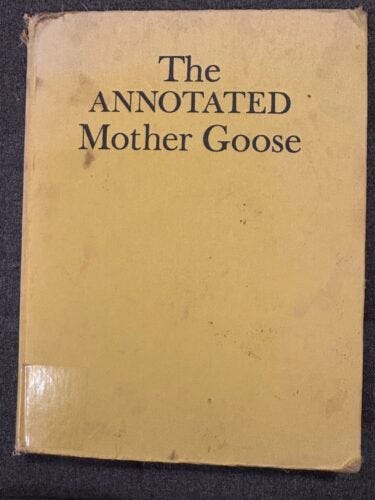
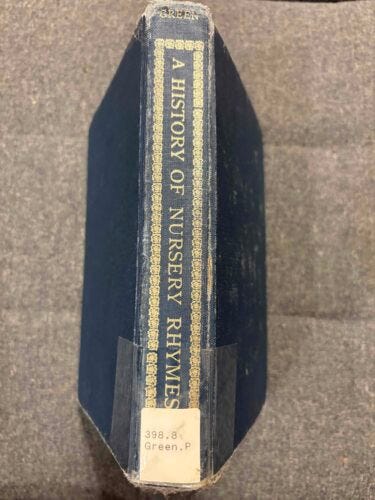
A certain kind of nerd might think, “I dunno. Those look pretty cool.”
Yeah. Until you open them up. A History of Nursery Rhymes, for example, is so egregiously racist that I found my jaw dislocating from my skull as I read through it. About the time it started talking about how ancient humans had “only the limited intelligence of the modern Australian native,” I was kicking myself over the fact that it had somehow remained on our library shelves for as long as it had. But what do we have coming out today that can fill this void?
Behold the answer:
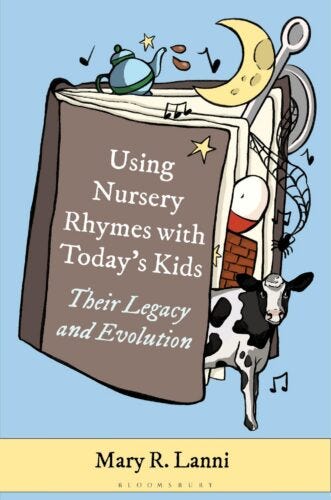
That’s better. Much much better. Published with Bloomsbury and out May 14th, Using Nursery Rhymes with Today’s Kids promises a contemporary peek behind the curtain of those rhymes we love so well. The publisher describes it this way:
“Nursery rhymes are easy to remember, recite, and pass on to future generations, but are these transmitters of popular culture still relevant and appropriate?
In an increasingly multicultural world, it’s critical to examine the lessons children are learning-both directly and indirectly-to ensure a positive collective future for everyone.
Readers are introduced to nursery rhymes from a historical and international perspective, where common themes and original intents are explored. The book highlights the importance of oral storytelling in cultures around the world and details the ways in which nursery rhymes provide young children with the tools to become strong readers. This guide also explores how popular modern children’s songs borrow from older tunes to be accessible to a contemporary audience.
An examination of the more nuanced elements of nursery rhymes highlights cultural changes that can affect the meaning of these older songs, questioning whether using the tune of a song with a problematic history is appropriate and whether altering only the offending words/phrases is sufficient to justify continued use. On-the-ground examples illustrate the ways in which songs can affect participants in different ways. Finally, the book helps readers make educated choices about how best to use nursery rhymes to support diversity, equity, inclusion, and accessibility.”
I love everything about this. But I had plenty more questions to ask:
Betsy Bird: Mary! Thank you so much for taking the time to answer some of my questions today! Nursery rhymes are, for a variety of reasons, very near and dear to my heart. As such, your book, USING NURSERY RHYMES WITH TODAY’S KIDS is a topic of great interest to me. Tell us a little bit about where you got the idea for the subject and what drew you to it.
Mary Lanni: Hi Betsy – thank you so much for including me! This book actually came about really organically. A couple of years ago, one of my colleagues asked me to put on a presentation for storytellers within my library system about nursery rhymes since the topic had become increasingly popular in library circles. So, I figured I could find the expert book on the subject, synthesize it, and present it to my team.
However, I quickly realized there was no such book and that I had a huge task of sifting through what information did exist in order to create a cohesive narrative.
Early literacy and community inclusion are of great importance to me, and so the limited awareness of nursery rhymes in general began to nag at me. After doing the research for this presentation, I figured that I might as well try writing the book I was looking for in the first place.
We dive deep into the rhymes, their necessity, phonological awareness, the whole thing. Read the full interview here.