Reflections of Identity
An Opting Out Conversation with Creators Maia Kobabe and Lucky Srikumar

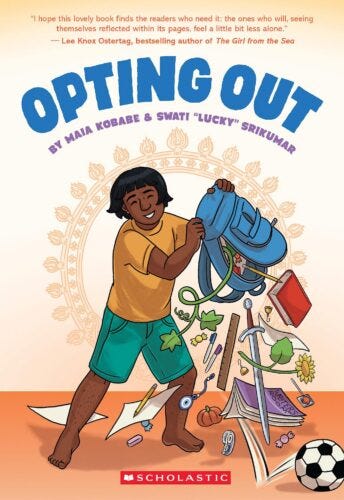
Each year my library (Evanston Public Library) produces a list of 101 Great Books for Kids. And because this list releases in late-October/early-November, it is important that we discuss potential titles for inclusion all year long in monthly meetings. Just yesterday we had our meeting to discuss the 2026 Fairytales/Folktales/Religious Tales AND Poetry AND Graphic Novels we’ve enjoyed as of late. And though I didn’t really mean to, I had a whopping eight new GNS to talk about (and that doesn’t even take into account the seven OTHER comics for kids that I think are above par). One of the titles that I got to present to the group? Opting Out by Maia Kobabe and Swati “Lucky” Srikumar (out now).
You may perhaps recall hearing the name “Maia Kobabe” somewhere in the past. It just so happens that Maia wrote a book by the name Gender Queer: A Memoir that, aside from winning a Stonewall Honor and an Alex Award in 2020, also became the nation’s most banned book from 2021-2023. Opting Out, in contrast, is Maia’s first middle grade graphic novel, and is being created along with Lucky Srikumar, who is also debuting.
The publisher describes it this way:
“Bodies are the worst. I wish I didn’t have a body.
Saachi is a storyteller. At school, she’s surrounded by kids she’s known forever — including her best friend, Lyla, who shares Saachi’s love of fantasy novels and creating new worlds.
But as seventh grade starts, kids are changing. Suddenly, it matters who you like and if you can find a boyfriend or girlfriend. Even Lyla seems more interested in hanging out with her new boyfriend than in writing and drawing with Saachi anymore. Saachi’s not interested in any of that boy/girl stuff. Why can’t things just stay the way they were?
Saachi also doesn’t love all the ways her body is changing. What if she doesn’t feel like a girl — or like a boy, either? In a world where there is so much either/or, Saachi is going to need to find her own options . . . and create her own story.”
And here are my own thoughts on the title from my own personal write-ups:
“A keen examination of the nebulousness of self that comes during adolescence. This drills into that time when people are slotting themselves into very distinct categories and where any deviation from those categories makes it difficult for the person in question. I cannot recall another middle grade or graphic novel that really dove into a person’s complete and utter disgust with the human body itself. Maia and Lucky do a great job with examining that aspect of Saachi’s experience.”
I’m downright honored to host both creators on this site today:
Betsy Bird: Maia! Such a delight to speak with you today! After working in the world of adult graphic novels it’s great to see you moving towards children’s for the first time. Why write OPTING OUT now? Where did the book come from?
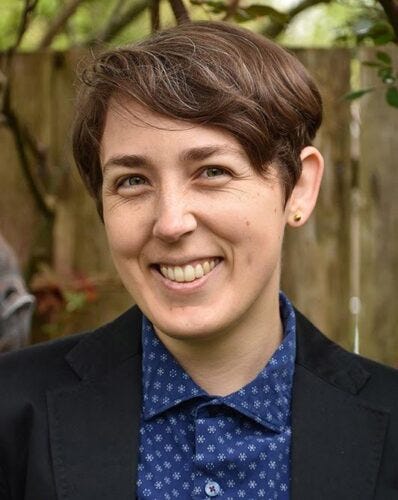
Maia Kobabe: When I was touring with Gender Queer all the way back in 2019, I had many parents of nonbinary or gender questioning kids tell me how much the book meant to them and how useful and encouraging it was in thinking about their kids’ potential futures. But often their kids were a little too young to read the book themselves, and so many parents asked me if I would consider making a “young reader” version of Gender Queer. I wasn’t interested in redoing the book I had just finished or in abridging my memoir, but that planted the idea in my head of writing a new book that covered many of the same themes and questions as Gender Queer but aimed at middle grade readers.
BB: Saachi’s ethnic identity could have been any number of things. I believe (and please correct me if this is inaccurate) she’s presented as Desi or Indian-American. I wonder if the both of you could answer if that always the plan from the start, or did you come to that decision later in the creative process? And Lucky, thank you too for taking my questions today. As far as I can tell, this is your first book for kids so far. How’d you get paired on the project, and did you know Maia personally previously?
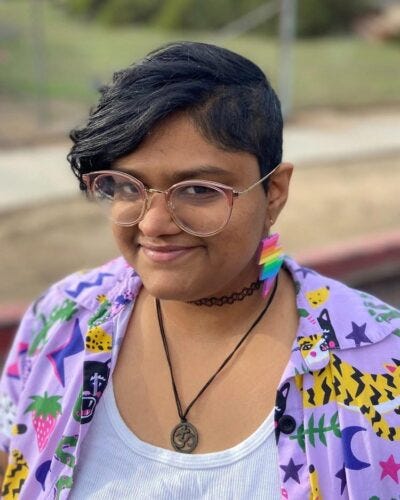
Lucky Srikumar: Hi! Thank you for having me! This is my first ever book and I’m so excited! Maia and I met over ten years ago through their sibling and my best friend, Phoebe Kobabe.
Maia had about 20 pages of a script written when e approached me, e actually paid me to give my opinion on whether the best friend character could be written as an Indian character.
I had a lot of thoughts but I did say that I would want the main character and their family to be Indian and Maia’s reaction was to invite me to join in and work on it with em and of course I couldn’t say no.
After that I ended up contributing to the art as well, helping with character designs and taking the lead on coloring the whole thing.
I feel so blessed to have gotten to work on this especially because I can’t picture the story without all these cultural elements anymore. It became it’s own thing and I’m so incredibly proud of it!
Maia: Lucky and I have known each other for over twelve years! They went to college with my younger sibling, Phoebe Kobabe, who helped with the colors on both this book and my first book, Gender Queer. Within one month or less of their friendship, Phoebe called me and said “I met the coolest person, you have to meet them!” That was the very beginning, and then about seven years after that we started working on this book together. I’m so so so happy with the result, in part because Lucky and I made a book together that could have only been created by the two of us together.
I asked Lucky if they would do a read of the book at a very early stage because I wanted to make at least one character Indian-American and I wanted their opinion on what I would need to change in the story to make that work. My initial idea was for the Indian character to be the best friend. Lucky suggested that the story would be much more interesting if the Desi character was the main character, and I agreed, but I knew I could only do that if Lucky was willing to join me as a co-author on the book. Happily, they said yes! Lucky then renamed everyone in Saachi’s family and wrote a lot of new scenes, including the majority of the scenes in which Saachi talks to her parents, and when they visit the temple, as well as many other contributions to the story.
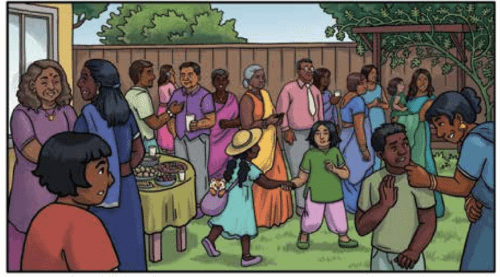
As it turns out, there is a lot more to discuss here. Everything from the character’s bowl cut to the puberty information that kids are going to find here first. It’s fascinating stuff. Read the full interview here.