Creating the “Third Artist”
A Styx and Stones Q&A with Gary D. Schmidt and Ron Koertge

By this point in the year the novels for kids are beginning to fall into place. We still have yet to see the bulk of the fall releases, but in terms of spring and summer there have been ample delights. One glance at the most recent Heavy Medal post, discussing how we are halfway through the year, is enough to show us that.
That said, it can be difficult to sort out the books if you haven’t read them. I find that getting a bit of background information on a title is an excellent way for teachers, librarians, booksellers, and guardians to tell the newest books apart. And when one has the opportunity to interview both Gary Schmidt AND Ron Koertge about their Greek myth-infused Styx and Stones (out now), one does so. Rapidly. With fervor.
Before getting into all that, though, let’s get a rundown on what the book is about from the publisher:
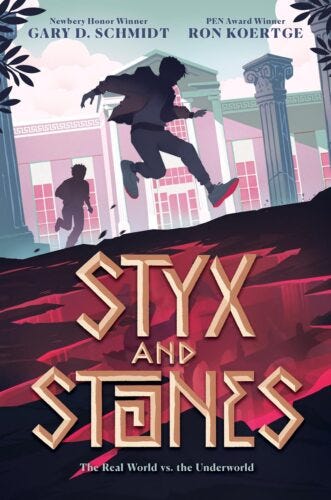
“Simon expected more from life than being orphaned in ancient Greece and stuck in the Underworld for eternity. Determined not to forget who he is, he commits himself to escaping Hades. Along the way, he faces the monster Cerberus, befriends the tormented Sisyphus, and becomes Persephone’s favorite servant. Then, after centuries of failed attempts, he is finally thrust into modern times—and into the stall of a middle school bathroom. Naked.
With the help of Zeke, a nerdy rich kid on the social fringes, Simon learns to navigate this amazing and bewildering world. And with Simon’s help, Zeke begins to question his comfortable life and understand the true meaning of friendship. Everything seems to be going great . . . until the god of the Underworld sends a demon girl to bring Simon back. And suddenly, it’s not just the secret of Simon’s past that’s threatened, but their very lives—and everyone’s around them, too. Is their friendship strong enough to withstand the Will of Hades and save St. Nikolaos Academy Middle School?”
You have questions? These guys have answers:
Betsy Bird: Hi guys! Many thanks indeed for answering my questions today. So this is hardly the first time you’ve worked on a project together. In an interview from 2025 you conducted with PW, Gary said, “I remember emailing you about three different projects and saying, ‘How about you pick one?’ Remember what you wrote back? ‘Let’s do all three.’ And now we’re on number four!” You seem to have this down to a science! But if this is number five, who proposed it initially? Where did the notion for it come from?
Gary Schmidt: Betsy, we’re actually still on those early projects; this is Number Two, following A Day at the Beach, which came out last year. We’ve been working on an epistolary novel together, and that will be our third. I’m not sure we have this down to a science, since each of the books is very different: a collection of short stories, then a novel, then a grouping of letters. I guess that’s not efficient, but it’s a blast to try our hands at something very different each time.
Ron Koertge: I remember being impressed with how often Gary had ideas for so many projects. When Coaltown Jesus came out in 2013, I told my wife that I might be done with KidLit. That book—a Novel-in-Verse—was barely 120 pages and honed to a razor’s edge. I’ve been a poet all my life and I tend to wait in silent expectancy for what the Quakers call “the way.” It took a while, but when Gary wrote about working together, that was the way.
BB: This would be your first dual entry into middle grade fantasy, territory of the ubiquitous Percy Jackson (to say the least). Yet you still assumed the mantle of Greek myths, to a certain extent, for this book. What, for you each personally, would you say is the allure? Why can’t we quit those dang gods?

Gary: I think the gods fascinate us because they’re so incredibly fallible. When I did The Labors of Hercules Beal, that’s what drew me in: Hercules (the mythical one) makes so many stupid mistakes, and the results, because he’s a god, are huge and beyond awful. The Norse gods are fascinating because of what hangs over all of them through all the stories: they know as a certainty that the gods will fall to the ice giants. That’s a given. But with the Greek stories, there’s the fact that the gods are often flawed—and sometimes horribly flawed. Zeus, after all, is a rapist. Hera is overwhelmed by jealousy. Poseidon is the thwarted and resentful lesser brother. And on and on. Rick Riordan captures this in the early Percy Jackson books, in which Apollo is a failed father. We can’t quit the gods because they are ourselves.
Ron: Completely agree with Gary. I was raised with fire-and-brimstone. Church twice on Sundays, prayer meeting Wednesday night, bible study at someone’s house. It’s no wonder I preferred the error-prone and admirably imperfect Greek belief system. I was less interested in a traditional heaven with streets of gold and preferred the Isles of the Blessed with Achilles and Ajax. Always a smarty-pants, I have a book of prose poems from an indie press called Olympusville where I re-write some of the foundation tales of the Greek myths. You won’t find me re-telling Bible stories!
As you can probably tell, these two know how to do an interview. Storytellers to their core, read on here to learn more about how one precisely goes about co-writing a book with another person when that other person isn’t in the same room with you.